
Storyworth: As Seen in NYT, CNN & More | July 2026
If someone you trust told you a product was worth it, you'd probably believe them faster than any ad could convince you. That's more or less what's happened with Storyworth. The New York Times editors, Wirecutter reviewers, and journalists at CNN have each looked at what family storytelling gifts are out there and kept arriving at the same answer. This post walks through what they found and why it matters if you're thinking about giving something that lasts.
TLDR:
- Editorial mentions in The New York Times and CNN carry weight because they come from independent reviewers, not paid placements.
- Research by Marshall Duke and Robyn Fivush at Emory University found that children who know their family history show stronger resilience, making story preservation more than a keepsake project.
- Specific question prompts surface clearer memories than open-ended invitations to "write something," which is why prompted formats tend to succeed where blank journals don't.
- Reviewers across outlets consistently look for the same things: low friction for the storyteller, flexibility for different communication styles, and a physical book families can return to.
- Storyworth Memoirs has been named the best family storytelling gift by Wirecutter and featured by CNN, Good Housekeeping, Forbes, and The Strategist, with more than 63,000 verified Trustpilot reviews (over 50,000 of them five-star) reflecting the experience after the gift is given.
What it means when the New York Times recommends something
When The New York Times covers a product, it goes through layers of editorial scrutiny that most publications never apply. Journalists at the Times are not working from a press release or a sponsored brief. They are researching, testing, and making independent judgments about what is actually worth recommending to their readers.
That context matters here. A mention in The New York Times is not an advertisement. It is an editorial endorsement, and the distinction carries real weight.
Storyworth has earned that kind of coverage more than once. Reporters and gift guides at the Times have pointed to Storyworth Memoirs as a meaningful option for families who want to preserve a loved one's stories in a lasting, physical form. The recommendation tends to appear in gift-focused coverage, where editors are looking for products that offer something beyond the typical, something that creates a real and lasting connection between people.
Why editorial gift recommendations are different
Gift guide recommendations in major outlets follow a different standard than general product coverage. Editors reviewing gift picks are weighing a few things at once:
- Whether the product delivers on what it promises, in theory and in the experience of actually using it
- Whether the emotional payoff matches the price point and the occasion
- Whether the product is the kind of thing a reader could feel good giving, knowing it will matter beyond the moment of unwrapping
Storyworth Memoirs fits that frame. The product results in a hardcover keepsake book, an e-book, and an audiobook, all built from a year of guided storytelling. That combination of process and output is rare, and it reads clearly to editorial reviewers as something worth recommending.
What third-party coverage signals to readers
For someone who has never heard of Storyworth, seeing it covered in the New York Times or CNN can answer a question that no product page fully answers on its own: can I trust this? Third-party coverage from sources with strong editorial reputations acts as a signal that independent reviewers looked at the product and found it worth their readers' attention.
That signal carries more weight for gifts in particular. When you are giving something to a parent or grandparent, you want some assurance that it will land well, that the experience will be good, and that the finished product will feel like something they treasure. Media coverage from trusted sources offers a kind of external validation that helps close that gap.
That validation shows up in concrete ways. The New York Times called Storyworth "The best gift I ever gave my dad", and said that, "…the whole family, including future generations, will benefit from it, one story at a time." Quotes that carry weight precisely because they come from editorial coverage, not advertising. Wirecutter's process reinforces the same point: their team interviews real families before publishing a verdict, so a top recommendation there reflects the experience of people who actually used the product, not merely tested it in a lab. For a first-time buyer who has never heard of Storyworth, that combination (editorial recognition plus a pattern of real-world experience reflected in more than 63,000 verified Trustpilot reviews) answers the trust question in a way no product page can.
Why family stories matter more than we realize
Research consistently shows that family stories do far more than entertain. They shape identity, build resilience, and give people a sense of where they belong in the world.
Marshall Duke and Robyn Fivush at Emory University spent years studying what they called the "intergenerational narrative," meaning the degree to which children know the stories of their family's past. Their findings were striking: children who knew more about their family history showed stronger resilience and higher self-esteem than those who didn't. The New York Times covered this research extensively, noting that children with the most self-confidence share a strong "intergenerational self," a sense of belonging to something larger than themselves. The stories themselves, passed from one generation to the next, turned out to be one of the most protective things a family could share.
This research matters because most families tend to underestimate how much is quietly at stake in the ordinary act of telling stories across generations. A grandparent recounting her childhood, a father describing his first job, a mother reflecting on what she wished she had known at twenty: these moments feel casual, even accidental. But they carry weight that lasts.
That recognition of what really matters is what Storyworth was built around from its beginning. Nick and Krista Baum founded Storyworth in 2013 as a family-owned, independently run company with no outside investors and no advertisers, a deliberate choice that keeps the focus on families and their stories, not on monetizing data or chasing growth metrics. More than a decade later, families have used Storyworth to share over 35 million stories, resulting in more than one million printed books. That track record reflects how many families decided the stories were worth capturing, and how many followed through once they had some structure and a weekly question to guide them.
What gets lost when stories go untold
The problem is that most of those stories never get captured. People assume there will be time later, that the stories are already somehow known, or that the person telling them wouldn't want to go through the trouble. And then, gradually or suddenly, the chance passes. There are several methods to preserve grandparents' stories before that window closes.
A few patterns tend to get in the way:
- There's rarely a natural opening. Most conversations between family members stay surface-level: schedules, logistics, quick check-ins. The deeper questions never quite surface.
- Memory is perishable. Even for the person living the story, details fade over time. The sensory specifics, the emotional texture, the names of people who mattered: these erode without reinforcement.
- Distance compounds the silence. Families spread across cities and time zones lose the informal rhythms that used to carry stories naturally from one generation to the next.
Why the right question changes everything
Duke and Fivush's research pointed to something practical, too: knowing a family's history requires someone to actually ask about it. Stories don't surface on their own. They need a prompt, a moment of invitation, a reason for the teller to reach back.
That's the insight Storyworth Memoirs was built around. Each week, the storyteller receives a single question by email or text, something like "What was your neighborhood like growing up?" or "What's a decision you made that you're especially proud of?" and responds in their own words, at their own pace. No app, no login required to reply. Just a question worth answering.
Over the course of a year, those weekly responses add up to something no one expected when they started: a full memoir, told in the storyteller's own voice, gathered one meaningful exchange at a time. Storytellers can also add unlimited photos alongside their stories, which appear in the final printed book.
What makes a prompted memoir different from a blank journal
When someone sits down with a blank journal and the intention to write their life story, the page itself offers no help. There's no question waiting, no gentle nudge in a direction, no structure to hold the memory in place. Most blank journals end up with a few pages filled and years of empty ones. A memory book for family stories takes a different approach entirely.
Prompted memoir formats work differently. Instead of asking someone to generate both the question and the answer, they separate those two tasks. The storyteller receives a question and only has to do one thing: remember.
Researchers who study autobiographical memory have found that retrieval cues, specific prompts tied to time, place, or sensory detail, are far more effective at surfacing vivid memories than open-ended invitations to "write something." A question like "What did Sunday mornings look like in your childhood home?" pulls on a specific moment in a way that "write about your childhood" simply doesn't. The cue does the excavation; the storyteller supplies the details.
That's where the depth of Storyworth Memoirs' question library becomes meaningful in practice. The library holds more than 500 prompts spanning childhood, relationships, work, travel, family traditions, military service, and values, browsable by category or searchable by keyword, so a family can queue up questions that speak directly to the life they want to capture. Magic Questions goes a step further: share details about the storyteller (where they grew up, the names of their children, their hobbies) and Storyworth instantly generates custom prompts tailored to that specific life, instead of drawing from the general library. A daughter who knows her father spent years working on a fishing boat might find Magic Questions surfacing prompts she never would have thought to ask herself. The result is a question stream that feels personal and specific, which tends to produce stories that feel the same way.
One detail that matters more than many families expect, especially for storytellers who didn't grow up writing, is what happens to stories before they go to print. Storyworth has a built-in proofreader plans that catches spelling, grammar, and punctuation before a story is added to the book. It doesn't alter the storyteller's voice or rewrite their sentences; it simply flags what might be a typo or a run-on so the storyteller can decide whether to fix it. For a grandparent who worries their writing isn't polished enough to go in a book, that safety net can make the difference between stories shared freely and stories held back.
Why the weekly pace matters
There's also something meaningful about the rhythm of one question per week. Writing an entire memoir feels like a project, which is easy to put off. Answering one question feels like a conversation, which is easy to say yes to.
Over the course of a year, those individual answers add up to something larger: a portrait of a life told from many angles, childhood and work and love and loss and the small moments in between. No single response feels like a burden, but together they form something complete.
Storyworth Memoirs is built around exactly this structure, and one of the things that sets it apart is that it never prescribes how a storyteller has to respond. Each week, a question arrives by email or text, and storytellers can share their answer in whichever way feels most natural to them. They can reply directly to the email or type on the Storyworth website (no login needed, because a sign-in link is built right into every weekly message). Storytellers who'd rather talk than type can use Storyworth Voice, the umbrella name for three phone-based methods that work on any phone, including a landline, with no app, no password, and no download required. Story Calls let a storyteller request a call; Storyworth then calls them directly so they can tell their story aloud, with the conversation transcribed word-for-word, preserving their natural voice exactly as spoken. Magic Interviews take a different approach: Storyworth calls the storyteller, asks follow-up questions to draw out details, and then shapes the conversation into a polished narrative, the closest thing to a done-for-you storytelling experience the product offers. Family Calls add a third phone option: a friend or family member can join the call to ask questions and share memories alongside the storyteller, turning the conversation into a story that can appear in the final book.
At the end of the year, all five of those story-sharing paths lead to the same destination: a printed hardcover memoir that also comes with an e-book and an audiobook version. Friends and family added to the storyteller's account can read along as stories come in, reply with their own comments and memories, and those contributions can be included in the final book too. Every printed copy also includes a QR code that connects readers directly to any voice recordings captured along the way, so the voice behind the story stays part of it.
A blank journal leaves everything up to the writer. A prompted memoir gives the story somewhere to begin.
What The New York Times Wirecutter review actually said
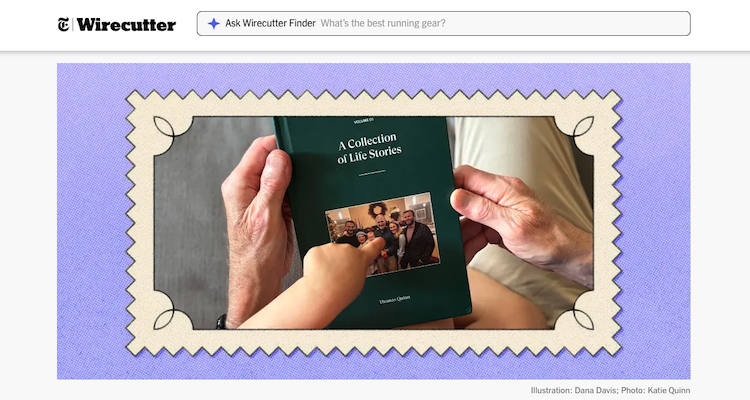
Wirecutter, the product review arm of The New York Times, put Storyworth through a thorough evaluation and named it the best family storytelling gift you can buy. That kind of recognition carries weight: Wirecutter's team tests products hands-on and interviews real users before publishing a verdict, so a top recommendation there isn't a marketing badge. It's the result of actual scrutiny.
The review pointed to a few things that set Storyworth apart from the alternatives they tested.
What Wirecutter's reviewers found most compelling
Wirecutter looked at the full experience, from the first question sent to the finished book in hand. A few findings stood out:
- The weekly question format made the process feel manageable, never overwhelming. Instead of asking a family member to sit down and write their life story, Storyworth Memoirs sends one question at a time by email; the storyteller replies when they're ready, with no login required. Over the course of a year, those replies add up into something real.
- The quality of the printed book was a meaningful differentiator. Reviewers noted that the finished memoir looks and feels like something you'd find in a bookstore, not a print-on-demand novelty. The book layouts were professionally designed with care given to how stories and photos are arranged on the page.
- The gift framing resonated with Wirecutter's audience. Reviewers described Storyworth as a gift that keeps giving throughout the year, with the storyteller receiving a new prompt each week instead of a single item unwrapped and set aside.
Wirecutter also noted that Storyworth works especially well for families where a loved one might be hesitant about tech. Responding to a weekly question is as simple as replying to an email, with no apps, no accounts, and no learning curve.
The quality of the finished book itself is another place where the real-world experience holds up. Storyworth's book layouts were redesigned in 2025 by book designer Carol Ly, resulting in a modern, bookstore-quality 6" × 9" hardcover with professional layouts and photos that automatically resize and snap into place alongside each story. Storytellers can include unlimited photos, with captions woven throughout the text, which means a life told in images as much as words. Every printed book also includes a QR code that links directly to any voice recordings captured via Story Calls, Magic Interviews, or Family Calls, so readers can hear the storyteller's voice simply by pointing a phone at the page. And alongside the hardcover, every Storyworth Memoirs order comes with an e-book, an audiobook, and access to a private podcast feed: four formats, each suited to a different way of returning to the stories over the years. More than 63,000 families have left verified reviews on Trustpilot, with over 50,000 of those reviews rated five stars, which gives editorial teams an unusually strong signal that the experience holds up long after the wrapping paper is gone.
Why this kind of press coverage matters
A Wirecutter recommendation carries a particular kind of trust that advertising cannot replicate. Readers come to Wirecutter because they want an independent opinion, not a sales pitch. When the review concluded that Storyworth Memoirs was the best option in its category, that conclusion came from comparison shopping on the reader's behalf, the same thing someone might spend hours doing on their own.
For families who are weighing whether to give Storyworth Memoirs as a gift, that third-party validation can matter. It answers the quiet question of whether this is something that actually works as described, or something that sounds better in theory than in practice.
Other outlets and voices that have recommended Storyworth
Storyworth has been recognized by a wide range of writers, editors, and journalists beyond the major outlets covered above. That breadth of coverage reflects something worth noting: the people recommending Storyworth tend to come from genuinely different corners of the media world, which suggests the appeal lands across different audiences and contexts.
A few of the outlets and voices that have featured or recommended Storyworth:
- CNN has included Storyworth in its gift guides, pointing to it as a thoughtful option for families who want to give something with lasting meaning, not something that gets returned or forgotten after the holidays.
- Good Housekeeping, which has built its editorial reputation on practical, tested recommendations for home and family life, has featured Storyworth as a standout gift for parents and grandparents.
- USA Today and its affiliate network of local publications have included Storyworth in gift roundups, bringing it to readers who may not encounter it through traditional lifestyle media.
- Wirecutter, known for its rigorous, consumer-first approach to product recommendations, has featured Storyworth for readers looking for a structured, dependable way to capture family stories.
- The Strategist (New York Magazine) has featured Storyworth as a recommended gift, bringing it to readers who actively seek out well-researched picks for the people in their lives.
What ties these mentions together is that they come from outlets with different editorial standards, different audiences, and different reasons for writing about gifts and family. When a product earns a place in a Wirecutter feature and a Strategist recommendation in the same year, it tends to mean different editorial teams arrived at the same conclusion independently. That kind of coverage carries more weight than a single high-profile mention.
What reviewers and experts look for in a family storytelling gift
When journalists, gift editors, and family history researchers talk about what makes a storytelling gift worth recommending, a few qualities come up again and again. The gift has to do more than promise to preserve memories; it has to actually follow through, in a way that works for the whole family, including those who aren't already comfortable with tech.
Here's what tends to matter most to reviewers who cover this space:
- Ease of use for the storyteller, especially older adults who may not want to download an app or create an account just to share a memory. The best services meet storytellers where they already are, whether that's email, a phone call, or a simple web page.
- A finished product that families can hold. Digital archives have their place, but reviewers consistently note that families return to physical books in a way they rarely return to folders of files. A bookstore-quality hardcover that sits on a shelf gets passed around; a link gets forgotten.
- Gentle, consistent prompting that makes it easy to keep going week after week. One of the most common reasons storytelling projects stall is that the storyteller doesn't know what to say next. Good question prompts solve that problem before it starts.
- Flexibility for different kinds of storytellers. Some people love to write; others would rather talk. A service that only supports one mode will inevitably leave some families behind.
- Trustworthy editorial and print quality. Reviewers who have actually held the finished books tend to care about how they look and feel, and how well the service works.
Storyworth Memoirs has been recognized in outlets like the New York Times, CNN, and others partly because it holds up well against all of these criteria. The weekly question arrives by email, requires no login to answer, and works on any device. Storytellers who'd rather speak than type can use Storyworth Voice: three phone-based methods that work on any phone, including a landline, with no app or password required. Story Calls transcribe a storyteller's spoken answer word-for-word, preserving their natural voice without alteration. Magic Interviews guide the storyteller through a conversation and shape the result into a polished narrative. Family Calls invite a loved one to join the call and help draw out the story together, a feature that turns what might otherwise be a solo project into an ongoing shared experience throughout the year. Every Storyworth Memoirs order includes a professionally designed hardcover book, an e-book, and an audiobook, along with a QR code that connects readers to any voice recordings captured along the way. For reviewers, that combination (five distinct ways to share a story, a low-friction weekly rhythm, and a lasting physical keepsake) is what tends to earn a recommendation across outlets with very different audiences.
For reviewers, the combination of low friction at the front end and a lasting physical keepsake at the back end is what tends to earn a recommendation.
How family storytelling services differ from each other
Family storytelling services share a common goal, but they take meaningfully different approaches to how stories get collected, preserved, and shared. Understanding those differences can help you find the right fit for what your family actually needs.
Here are the main dimensions worth thinking through:
How stories are collected
Some services build around voice recording, asking storytellers to speak their memories aloud through an app or phone call. Others center on written responses to weekly question prompts delivered by email. A few offer both. The right approach often depends on the storyteller: someone who finds typing difficult may open up more naturally over the phone, while someone who prefers to reflect before responding tends to do better with written prompts they can answer at their own pace.
What shape the final product takes
This is one of the clearest points of difference. Some services produce a printed book at the end of the year. Others keep stories in a digital archive. Some deliver audio files or recordings as the primary keepsake. A few do a combination. If holding something physical matters to you, and to the storyteller, a service that ends with a printed book may suit your family better than one that delivers a digital-only experience.
Who can participate
Certain services focus on a single storyteller responding to prompts. Others invite the whole family to read along, leave comments, contribute their own memories, and shape the story as it comes together over time. If you want the experience to feel like a family project and not a solo one, that distinction matters.
The questions themselves
Some services offer a fixed set of prompts. Others let you customize, swap in your own questions, or draw from a large library organized by theme. For families with a specific era or experience they want to capture, the ability to steer the question stream can make a real difference in the kinds of stories that surface.
What happens at the end
The final product varies widely across services: a hardcover book, an e-book, an audiobook, a digital archive, a series of audio recordings, or some combination. It's worth thinking about what format the storyteller and their family will actually return to over the years, beyond what simply feels impressive at the moment of gifting.
Why Storyworth has earned consistent expert recognition
Storyworth has been covered by some of the most trusted names in media, and that recognition tends to follow a consistent thread: journalists and gift editors who set out to find something genuinely useful for families keep arriving at the same answer.
The New York Times has featured Storyworth as a recommended gift for parents and grandparents, placing it alongside products that the paper's editors test and stand behind. CNN has included Storyworth in its gift guides as well, a category where the bar for inclusion is high and the editorial team tends to favor products with a clear, proven purpose. Other outlets, from lifestyle publications to family-focused editorial roundups, have pointed readers toward Storyworth for similar reasons.
What tends to come through in these write-ups is less about features and more about what actually happens when someone gives Storyworth Memoirs as a gift. Editors describe it as something that prompts real conversations, the kind that might not have happened otherwise. That's a harder thing to manufacture than a clever piece of hardware, and it seems to be what keeps Storyworth showing up in these lists year after year.
There's also the reader response. Storyworth has more than 63,000 verified Trustpilot reviews (over 50,000 of them five-star), which gives any journalist covering it an unusually clear signal that the experience holds up after the wrapping paper is gone. Expert recommendations and customer experience tend to reinforce each other here, and that combination is part of why the coverage has been so consistent across outlets with very different audiences.
One practical reason families return to Storyworth over time, and one that comes up in reviews, is that the stories and recordings never disappear. Storytellers retain permanent access to everything they have shared, even after the subscription year ends, with no storage fees and no expiring links. That is a real structural difference from several other services in this space, which restrict or revoke account access once a subscription lapses, leaving families unable to view, edit, or reprint their stories without paying again. For a gift built around something as irreplaceable as a parent's memories, knowing those stories will remain accessible for as long as the family wants them is a meaningful assurance.
A few things the coverage consistently points to:
- The weekly question format makes the process feel manageable, never overwhelming, which matters for families who want to preserve stories but aren't sure where to begin.
- The final printed book, a hardcover keepsake that also comes with an e-book and audiobook, gives the whole year a real, lasting outcome that families can return to.
- Storyworth works across generations and tech comfort levels, since storytellers can respond by replying to a simple email, with no login or app required.
Final thoughts on what it means when editors keep recommending Storyworth
Not every product earns a Wirecutter top pick and a spot in The New York Times gift guide in the same year, and the reason Storyworth keeps showing up in both is pretty straightforward. The format works, the finished book looks and feels like something worth keeping, and the whole process is built around the storyteller, not around tech. Your family gets a memoir in their loved one's own voice, and the person telling the stories gets one manageable question a week. Storyworth Memoirs is a good place to start if you want to give a gift that actually lasts.
FAQ
Why does The New York Times recommend Storyworth?
The New York Times has featured Storyworth Memoirs in editorial gift coverage (not advertising) because it delivers on what it promises: a year of guided storytelling that ends in a hardcover keepsake book, an e-book, and an audiobook. Wirecutter, the Times' product review arm, named it the best family storytelling gift after hands-on testing and interviews with real families, pointing to the weekly question format, the quality of the printed book, and how well it works for storytellers who aren't comfortable with tech.
What's the best way to capture stories from a parent who doesn't like writing?
Storyworth Memoirs offers several ways to share stories beyond typing. Storyworth Voice gives storytellers three phone-based options that work on any phone, including a landline, with no app or password required. Story Calls transcribe spoken answers word-for-word; Magic Interviews guide the conversation with follow-up questions and shape the result into a polished narrative; and Family Calls let a loved one join the call to help draw out the story together.
Should I choose a prompted memoir service or just give my parent a journal?
A blank journal leaves everything to the writer (the question, the structure, and the motivation to keep going), which is why most go unfilled. A prompted memoir like Storyworth Memoirs separates those tasks: one question arrives by email each week, and the storyteller only has to remember and respond, at their own pace, with no login required.
How is Storyworth Memoirs different from other family storytelling services?
The clearest differences are in how stories get captured and how the whole family can be involved. Where many services offer one input method, Storyworth Memoirs supports five distinct ways to share stories: writing by email or on the Storyworth website, plus three phone-based voice options: Story Calls, Magic Interviews, and Family Calls. Friends and family added to the account can read stories as they come in, leave comments and memories that can be included in the final book, and the printed hardcover includes a QR code linking directly to any voice recordings captured along the way.
How do I know Storyworth actually delivers a quality finished book?
The book layouts were professionally redesigned in 2025 by book designer Carol Ly, producing a modern, bookstore-quality hardcover that Wirecutter reviewers pointed out felt like something you'd find in a bookstore, not a print-on-demand novelty. Every Storyworth Memoirs order also includes an e-book and an audiobook alongside the printed book, and more than 63,000 verified Trustpilot reviews (over 50,000 of them five-star) reflect how families have experienced the finished product firsthand.