

Preserve Grandparents Stories June 2026
If you've been thinking about the best ways to preserve family stories but don't know where to begin, you're not alone. Many of us listen to our grandparents' stories and wish there were an easier and simpler way to capture and turn them into a keepsake for the whole family. The challenge is finding a method that's simple enough for grandparents to use without relying on overly complicated technology, apps, or passwords, in order to create something the whole family can treasure for generations.
TLDR:
- Preserve grandparents' memories through email replies or phone recordings that get transcribed automatically.
- Weekly question prompts guide storytellers through a year of memories, creating a hardcover book with unlimited photos.
- Family members can read stories as they're written and suggest questions without overwhelming the storyteller.
- One guided storytelling service has helped families preserve 35 million stories and print over a million books since 2013.
- The best preservation method works without app downloads or logins, so grandparents can participate on their own terms.
What are family story preservation methods?
Family story preservation methods are the techniques and tools you can use to capture and preserve your grandparents' memories. These approaches range from handwritten journals and audio recordings to digital solutions that combine writing, voice capture, and photo integration.
The methods fall into several categories: physical formats like notebooks or scrapbooks, audio and video recordings, digital archives, or guided storytelling services that prompt and organize memories.
Each approach has trade-offs in terms of ease of use, completeness, and accessibility of the final result for future generations. Research on family stories and wellbeing shows that intergenerational knowledge of family history is associated with stronger mental health outcomes across generations.
How we ranked family story preservation methods
We tested each preservation approach against five main criteria.
Ease of use for elderly storytellers
The method your grandparents will use is the one that works. We looked for approaches that skip app downloads, password creation, and complicated interfaces. We asked ourselves: can your family members respond by email or phone? Is there a steep learning curve?
Interview guidance and question quality
Even with the right recording setup, getting grandparents to share meaningful stories depends on asking the right questions. Open-ended questions that invite reflection work far better than yes/no questions. A question like "What is one of your earliest childhood memories?" opens a conversation; "Did you have a good childhood?" closes it.
We considered whether each method offered built-in question prompts or left families to develop their own. Good prompts guide storytellers through specific memories rather than broad themes, and the best services deliver weekly questions that gradually work through different chapters of a life, childhood, relationships, career, and legacy.
A few examples of questions that tend to draw out genuine stories:
- "What is one of your earliest childhood memories?"
- "What are the most important lessons you've learned in life?"
- "How has the country changed during your lifetime?"
Services that deliver thoughtfully crafted weekly prompts help storytellers move through different phases of their lives at a comfortable pace, which produces more complete accounts than a single interview session.
At Storyworth, we built our question library around this exact idea. With over 500 prompts spanning childhood, career, relationships, and legacy, storytellers can browse by category or let a family member suggest a question, so the prompts guiding the year stay specific instead of open-ended. Families can also use Magic Questions, which suggests custom prompts tailored to a storyteller's own life, like their hometown, their children's names, or a hobby they've mentioned, instead of pulling from the library. Since 2013, this approach has helped families capture over 35 million stories, which suggests that the right question, delivered at the right pace, matters more than any recording technology. For a family working through a parent's or grandparent's memories, that specificity can be the difference between a few generic anecdotes and a book full of moments worth keeping.
Quality and completeness of final output
We looked at what you receive at the end: a physical book, digital files, or raw recordings. Does the final keepsake support photographs? Can you share copies with family? Will it feel like a keepsake or a scattered collection of files?
Storyworth's book layouts were redesigned in 2025 by renowned book designer Carol Ly, giving every memoir a modern yet timeless, bookstore-quality look. Every printed book also includes a QR code linking family members directly to any voice recordings captured through Story Calls, Magic Interviews, or Family Calls, so the physical book connects back to the sound of a grandparent's actual voice. Families can also add unlimited color photos throughout each story at no extra cost, so the finished book pairs every memory with the faces and places behind it. Beyond the printed hardcover, every completed memoir also comes with a free e-book and audiobook version, giving families more than one way to revisit the same stories for years to come.
Family involvement and collaboration
We checked whether multiple people can suggest questions, read stories as they're written, and contribute without overwhelming the storyteller.
Storyworth builds this kind of participation into the year itself. Either the storyteller or a loved one can request a Family Call, and Storyworth calls both of them so they can talk through a memory together in real time, with the conversation shaped into a polished story for the book afterward. Family Calls give families a regular reason to connect instead of a single interview squeezed into one afternoon. Recipients added to the account can also read stories as they're written, add their own comments and memories, and suggest new questions. Those reflections can even be included in the final book. For a family spread across cities or time zones, that ongoing thread of shared reading and commenting can turn a solo writing project into something the whole family experiences together.
Durability and long-term access
Digital files become obsolete, and recordings sit unwatched on hard drives. We considered whether each method creates something that will remain accessible to future generations without requiring specific tech or subscriptions.
Value and support
We weighed cost against what you receive, including customer support when families need help with technical issues or storytelling guidance.
Best overall family story preservation method: Storyworth
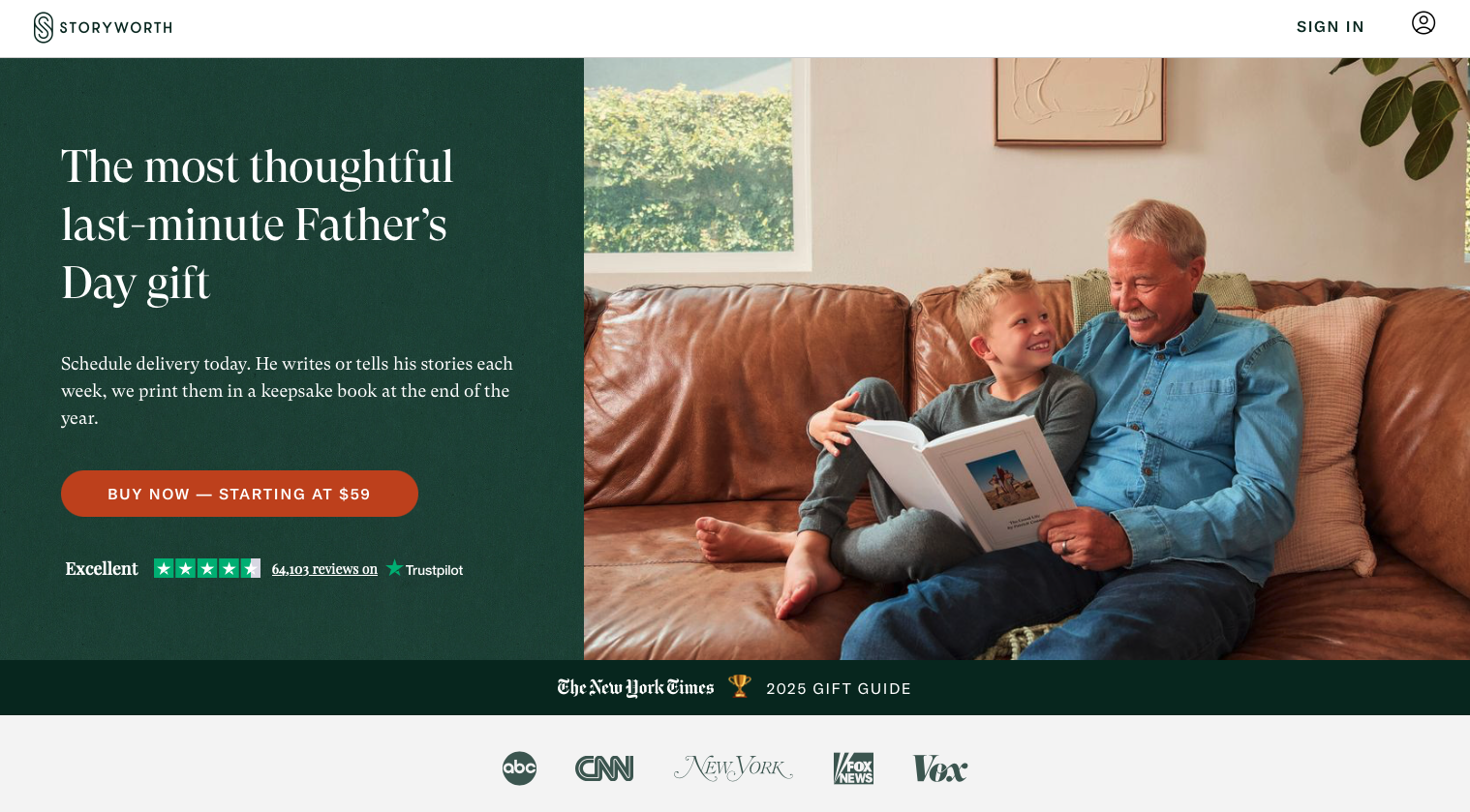
At Storyworth, we guide storytellers through a year of weekly questions designed to unlock meaningful memories, from childhood adventures to life lessons learned over the course of decades. The service combines thoughtful prompting with flexible recording options and professional book production.
How it works
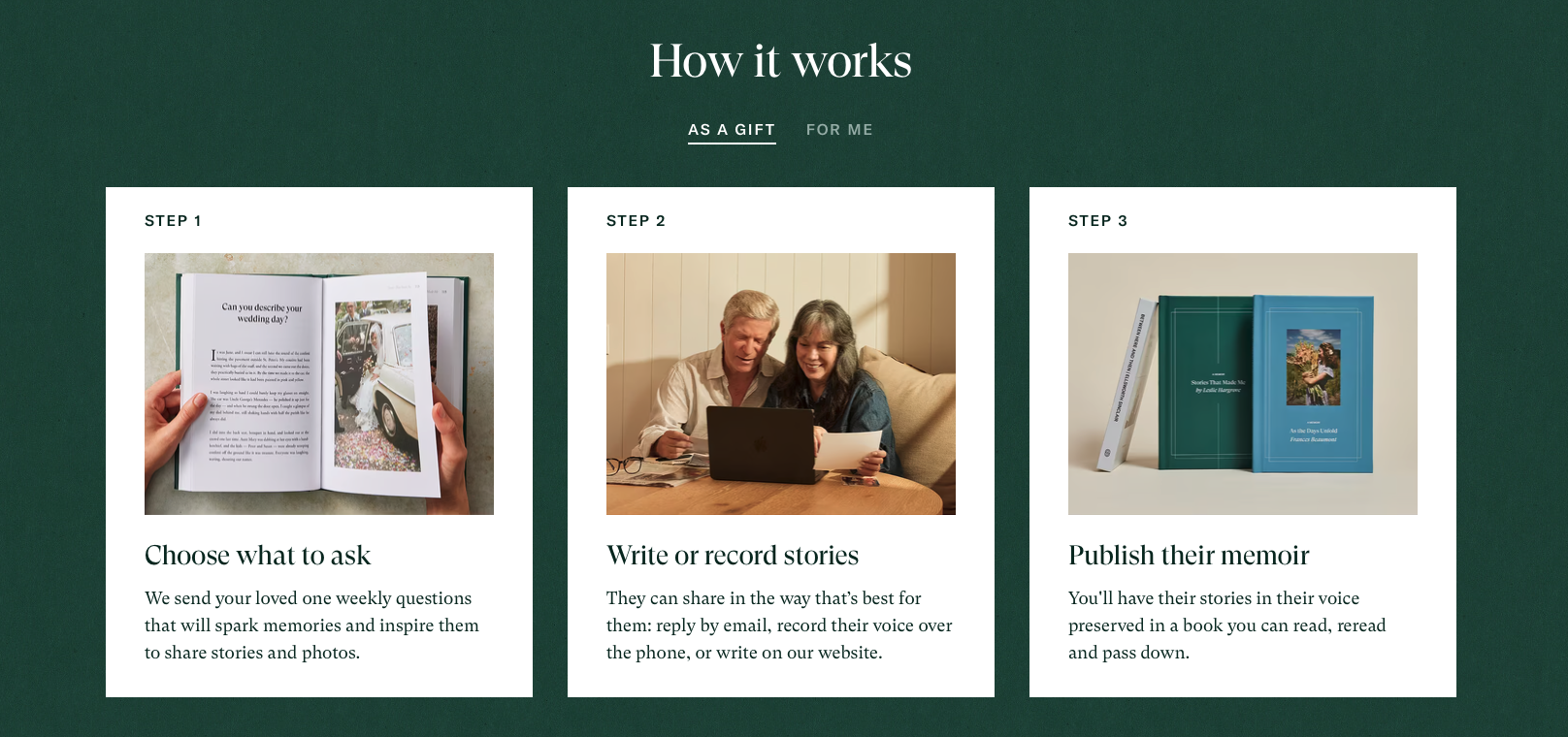
- Weekly question prompts arrive by email or text with no login required, making participation simple for any generation
- Five ways to share stories: reply by email, type on the website, or request a call using Story Calls (word-for-word transcription), Magic Interviews (guided conversation), or Family Calls (a loved one joins); Storyworth calls the storyteller directly, so there's no dialing in, no app, and it works on any device, including a landline
- Unlimited color photos can be woven throughout stories at no extra cost
- Professional hardcover books (up to 480 pages) create lasting family heirlooms
Storytellers also get access to our built-in proofreader, which catches spelling, grammar, and punctuation mistakes without changing how someone actually talks, so they can focus on reflecting and remembering instead of worrying about writing mechanics. For a grandparent who might otherwise hold back because they're worried their writing isn't polished enough, that safety net can be the nudge that keeps them answering questions past the first week. Storyworth Memoirs also works well as a last-minute gift, since it can be delivered instantly to their inbox with a personalized message. The year of weekly questions begins the Monday after the gift email is delivered to the storyteller, no matter when it's purchased. Whether you're buying it for a parent or a grandparent, or someone is choosing it for themselves, the goal stays the same: make it easy to start, so the stories can do the rest.
Plans start at $59 for a year of weekly questions and one hardcover book, with color printing, text delivery, and phone interview options also available. Not all features are available on every plan, so it's worth checking the plan details before you buy. Additional copies are available for extended family. Since 2013, we've helped families preserve over 35 million stories and print more than 1 million books.
Remento
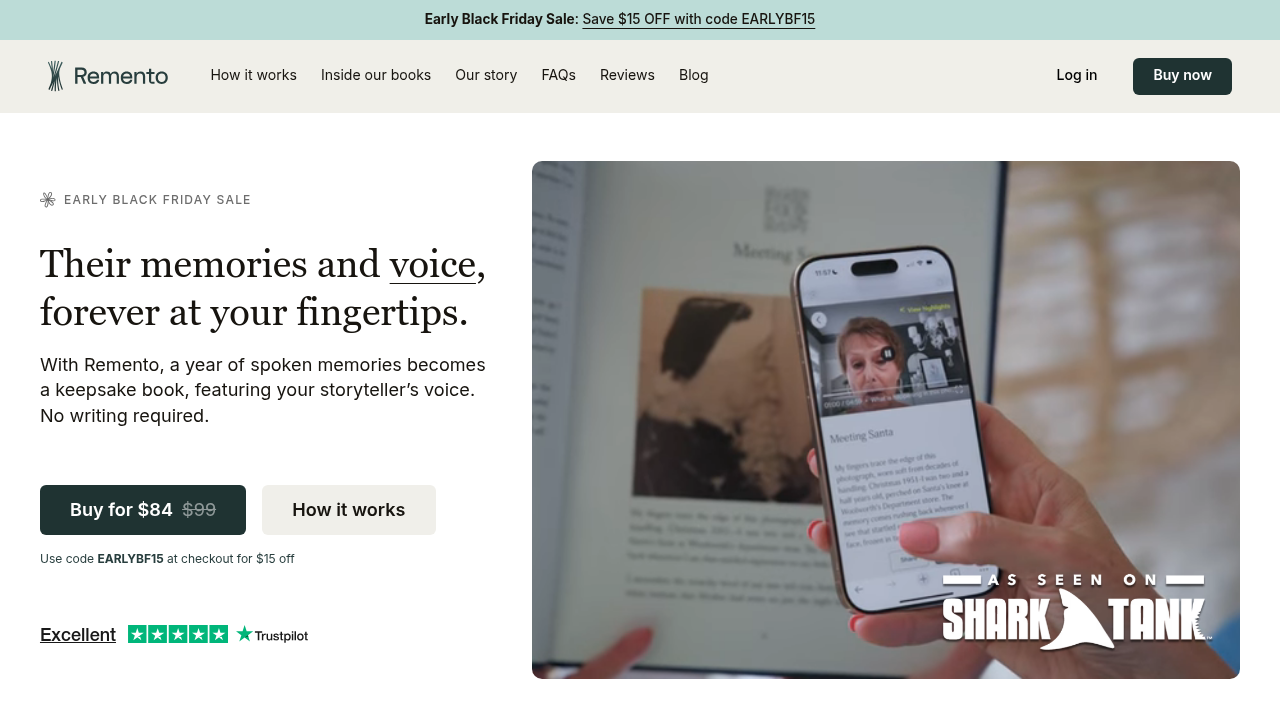
Remento focuses on audio and video recordings through an internet-connected device, like a smartphone or tablet. Storytellers receive question prompts and record their answers using their phone's camera or microphone. AI transcription converts recordings into text for the printed book.
The finished book includes QR codes that link to original recordings. Readers can scan codes to hear their grandmother's voice or watch their grandfather tell a story.
Getting started with Remento requires creating an account and downloading the app on an iOS or Android device. Once set up, storytellers open the app, select a question prompt, and record a video or audio response directly from their phone. The app handles transcription and organizes recordings into a timeline. This setup works well for grandparents who are already comfortable with smartphones, but the steps can feel daunting for those who do not regularly use mobile devices. Unlike services that work through a simple email reply Remento's workflow depends on a functioning smartphone and an active internet connection throughout the recording process.
There's no email reply or other writing option, but Remento now offers voice-only recording on landlines for storytellers who prefer not to appear on camera. The primary video-based workflow still requires a smartphone and an internet connection, which may present challenges for grandparents who prefer simpler methods. Remento also processes voice recordings through AI "speech-to-story" technology that rewrites spoken answers into a polished narrative. This can alter the storyteller's natural phrasing and remove the authentic voice that makes a family memoir meaningful. Storyworth's Story Calls transcribe recordings word-for-word, preserving exactly how your grandparent speaks. Remento also has limited customer service options: at the time of writing, these include email and a website chatbot, but not phone support, which can be particularly important for older adults.
MyLifeinABook
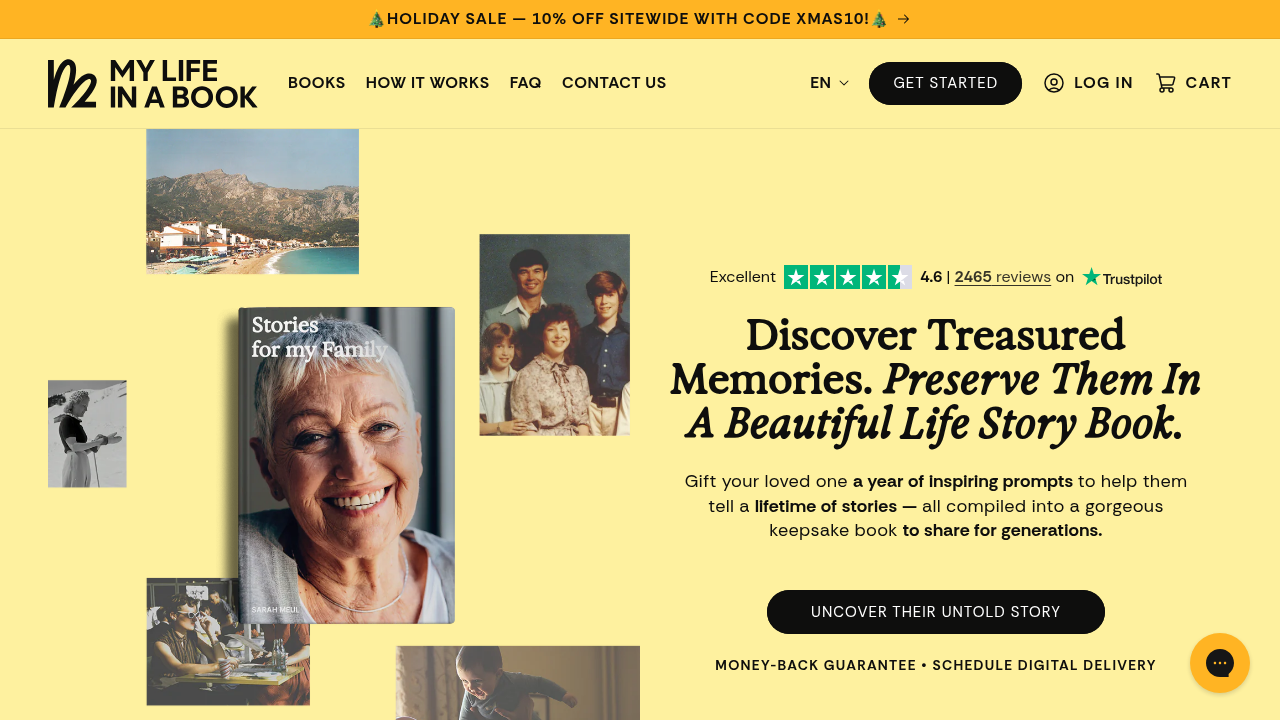
MyLifeinABook sends question prompts by email or through their website. Storytellers type responses that get compiled into a hardcover book with photos.
The service offers customer support for editing and layout questions. Families can customize prompts from the question library, and storytellers work at their own pace without weekly deadlines.
However, there are limited submission options. Storytellers must type all responses themselves, with no voice recording or transcription available. This can be difficult for grandparents with arthritis, vision challenges, or those who prefer speaking about their memories versus writing them down.
Storied

Storied pairs family tree building with story collection, allowing families to map genealogy while gathering memories. The service includes document preservation, photo archives, and collaborative features within an ancestry research framework.
Storytellers add written memories to specific family members in their tree, and invited relatives can contribute their own stories and historical documents. The final output includes genealogical charts and narrative content in printed or digital formats.
The genealogy focus means families work through family tree interfaces, research tools, and documentation features alongside storytelling prompts. For grandparents who want to share life memories without building ancestry charts or uploading census records, the extra features can feel overwhelming.
This works well when you want a family history that traces lineage and preserves stories. If your goal is to capture your family members' personal memories quickly, the genealogy component can slow things down.
Feature comparison table of family story preservation methods
| Feature | Storyworth | Remento | MyLifeinABook | Storied |
|---|---|---|---|---|
| Email reply (no login) | Yes | No | No | No |
| Phone recording with transcription | Yes | Yes | No | No |
| App required | No | Yes | No | Optional |
| Photos per story | Unlimited | Unlimited | Limited | Two photos per story; digital version can add up to 100 media items |
| Collaboration features | Family can suggest questions, read stories, comment | Family can view recordings, suggest questions | No family collaboration during writing | Family tree collaboration |
| Final format | Hardcover book | Hardcover book with QR codes to recordings | Hardcover book | Hardcover or digital with genealogy charts |
| Customer support | Email/text (24/7), phone during business hours | Email support | Email and phone support | Email support |
| Access after subscription ends | Permanent, stories and book always accessible | Limited, editing and printing access revoked when subscription lapses | Limited, access restricted once subscription ends | Permanent |
| Price (approximate) | Starting at $59 | $99 | Varies by package; starting at $59 | $99 |
Why Storyworth is the best family story preservation method
We designed Storyworth to meet grandparents where they are. Research shows reminiscence improves mental health in older adults, and grandparents consistently put family connections at the top of what matters most to them. Where Remento limits storytellers to app-based recording and Memorygram requires scheduling phone sessions with a virtual interviewer, Storyworth gives grandparents five ways to share stories: by email reply, on the Storyworth website, or by phone using Story Calls, Magic Interviews, or Family Calls. All phone options work on any device, including a landline, with no app or password required. With 63,000 verified Trustpilot reviews, more than 50,000 of them five-star, earned over more than a decade, Storyworth's record of quality far exceeds what Remento (around 1,000 reviews) and Memorygram (around 700 reviews) have built. When families need help, a real person answers by phone during business hours, not just an AI chatbot. You get your family's authentic voice preserved in a physical book that reads completely on its own, with no server access or QR scanning needed.
FAQs
How do I preserve my grandparents' stories if they're not comfortable with technology?
Look for methods that work through email replies or phone calls, not ones that require apps or logins. At Storyworth, your grandparents can respond to weekly questions by simply replying to an email or talking on the phone. We'll automatically transcribe their voice recording into their memoir.
What's the best way to include photos with my grandparents' stories?
Choose a preservation method that supports unlimited photos throughout the narrative, versus limiting you to one image per story. Photos with captions can be woven into the text to bring memories to life visually, and the best services include full-color printing at no extra cost in the final book.
How long does it take to create a complete family memoir?
Most guided storytelling services work over the course of one year, with weekly question prompts that gradually build a complete life story. This pacing prevents overwhelm while giving your family members time to recall details and share meaningful memories at a comfortable pace.
Final thoughts on preserving memories for future generations
Your family's stories are too important to leave scattered across old recordings or forgotten notebooks. Capturing memories becomes natural when your grandparents can share stories the way they prefer, whether that's writing an email response or recording their voice. If you're ready to get started, explore Storyworth's plans and find the one that fits your family.
